Approach · somatic work
Somatic therapy
Some things never made it into words, because they happened before you had any, or because saying them out loud was not safe at the time. Those things do not disappear. They get held: in a jaw that will not unclench, a chest that tightens when the phone rings, a stomach that knows an hour before you do. Somatic work is what I do when the useful material is clearly in your body and talking about it has stopped reaching it.
Telehealth only, by secure video or audio, for people physically located in California. Laurie, LMFT.

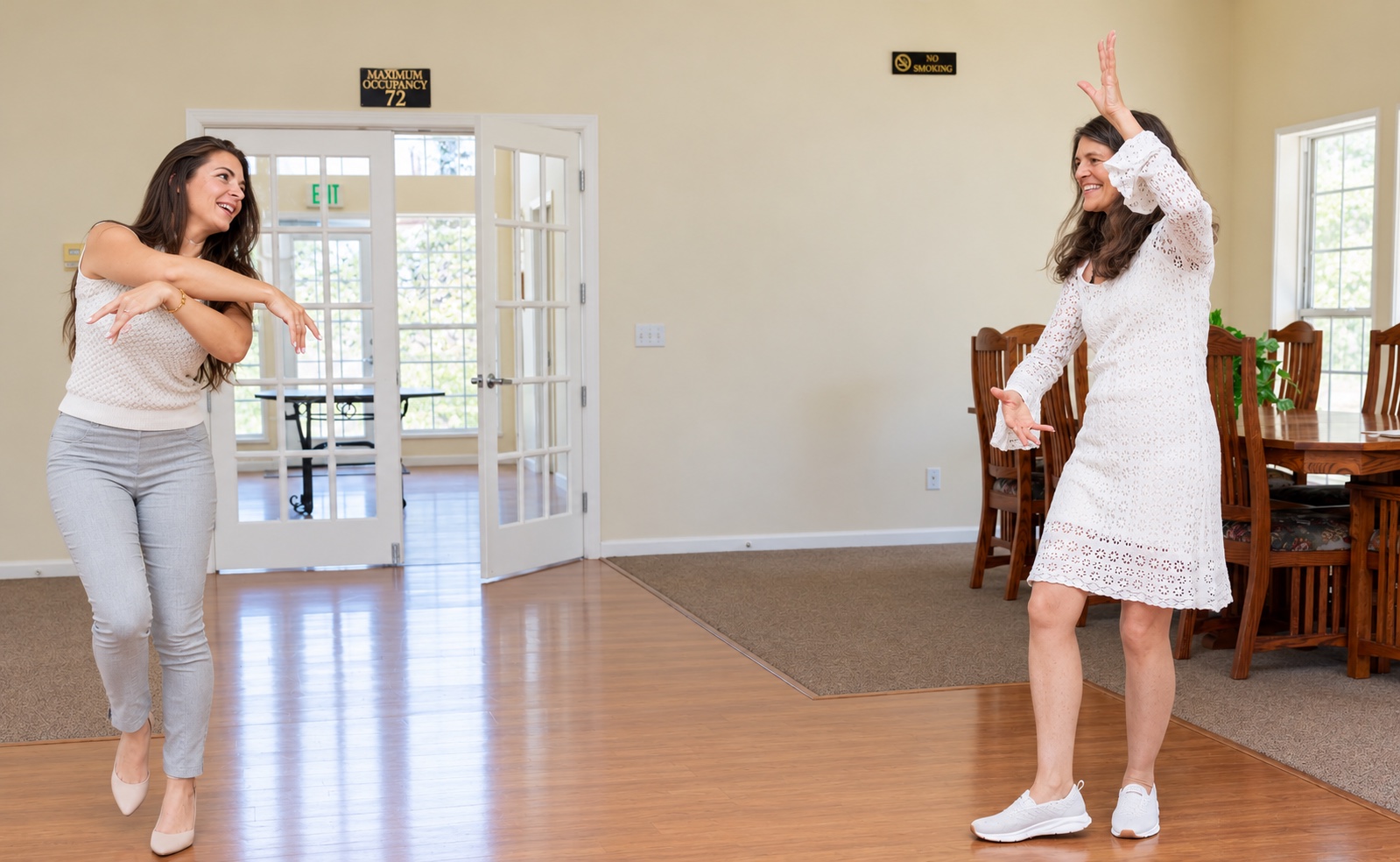
What somatic work looks like with me
It looks like a fairly ordinary conversation that keeps stopping. You will be telling me about the phone call with your brother, and I will ask you to pause, because something happened in your shoulders on the word 'again'. Then I ask what you notice there. Not what it means, not what it reminds you of, just what is actually present: tight, hot, hollow, still, buzzing. Most people cannot answer this at first and reach for interpretation instead, which is fine. The noticing gets easier within a few weeks.
We work in small doses on purpose. You put your attention on something uncomfortable for a short while, and then we go somewhere neutral: your feet, the light in your room, the weight of your own hands. That rhythm is the method, not a precaution around it. It is how a nervous system learns that it can approach something difficult and still come back, which is precisely what it stopped believing at some point.
Often a movement wants to happen and never got to. An arm that wanted to push, a body that wanted to run, a head that wanted to turn away. When there is room and no hurry, those completions sometimes arrive on their own, and people are frequently startled by them: a long shake, a sudden yawn, a full breath that goes lower than usual, tears with no story attached. I do not treat any of that as a breakthrough to chase. I treat it as your system finishing something it was interrupted in.
By video this is easier than people expect, because you are already at home. You can stand, lie on the floor, wrap yourself in a blanket, or turn the camera aside while something moves through. Nobody is watching you walk back out through a waiting room afterward.
The body is not being dramatic. It is reporting.
We go in small doses, and we always come back.
Where I find this fits
Grief the body is carrying
Grief is my primary specialty, and it lives in the body as much as the mind: the weight across the chest, the exhaustion that sleep does not touch, the appetite that left. Giving that somewhere to be felt often does more than another explanation.
Anxiety that is faster than thinking
When your body has already gone into alarm before you have had a thought, arguing with the thought is late. We work with the alarm itself, and with the small number of things that reliably bring your system back down.
Trauma held without words
Early experience, medical events, anything from before language. Somatic work is often the safest way in, and frequently what makes EMDR possible later. I am EMDR certified and we sequence the two according to what your system can hold.
Numbness and disconnection
Watching your own life from behind glass. We start with the smallest possible signals, well below emotion, and let range come back gradually rather than trying to force feeling.
Chronic tension and burnout
Years of holding it together leave a physical residue. For people who have been the capable one for a long time, learning what settling actually feels like is often unfamiliar work, and worth the time.
How we would work
We start with a free 20-minute consult by phone, text or video. You tell me what has been happening, including the physical part of it, and I tell you honestly whether I am the right fit.
If we go ahead, sessions are weekly by secure video or audio, and body-based attention runs through them rather than occupying a separate slot. Alongside it I use Internal Family Systems when a part of you objects to slowing down, mindfulness to steady attention, hypnotherapy, expressive approaches when movement or voice says what speech cannot, and my own Positive Re-Narrative and Repatterning when a physical reflex is one link in a much longer loop.
I work with adults, seniors, couples and families. I do not treat bipolar disorder or schizophrenia, and I will say so early rather than late if that is what is needed.
- Noticing before interpreting
- Small doses, with a return to neutral every time
- Orienting to the room you are actually in
- Letting interrupted movements finish, without chasing them
- Building two or three things that reliably settle you
- Sequencing body work with EMDR and parts work rather than stacking everything at once
Questions people ask about somatic work
- I do not feel anything in my body. Can I still do this?
- Yes, and you are describing one of the most common starting points rather than a disqualification. Numbness is not an absence of experience; it is usually something a person learned to do, often early, because feeling everything was not survivable at the time. We begin much smaller than sensation: temperature, weight, whether your feet are touching the floor, whether your breath is moving high or low. Those are noticing tasks, not feeling tasks. The rest returns in its own time, and I do not push it.
- Is this bodywork? Are you touching me?
- No. There is no touch in what I do, and by video that question answers itself, but I would give the same answer in a room. This is therapy in which your own attention goes to your own body, and you are the only one who moves it. Sometimes I will suggest you press your feet into the floor, or unclench a jaw you had not noticed was clenched, or let a hand rest where you feel something. You decide whether to do any of it.
- How does body-based work translate to a screen?
- Better than most people assume, because the material is inside you rather than between us. You are already in your own space, which means you can stand up, lie down, take your shoes off, put a blanket over your knees, or turn the camera away for a few minutes without any of it being strange. Several people have told me they could only do this kind of work at home. I can see your face and hear the change in your breath, and mostly I am asking you what you notice, which does not require me to be in the room.
- What if something big comes up and I cannot stop it?
- We work in small doses precisely so that does not happen. You touch the edge of something, we stay there briefly, and then we come back to something neutral. That back-and-forth is deliberate, and it is the core of the method rather than a safety extra. If something does surge, we stop the exploring and spend the rest of the session getting you oriented: what you can see in the room, what year it is, where your weight is. I would rather end an hour early and steady than complete an exercise.
If your body has been saying it for a while
You do not need to be good at feeling your body to begin. Almost nobody is at the start. Text or email and we will find a time to talk. Telehealth only, by secure video or audio, for people physically located in California. Laurie, LMFT.